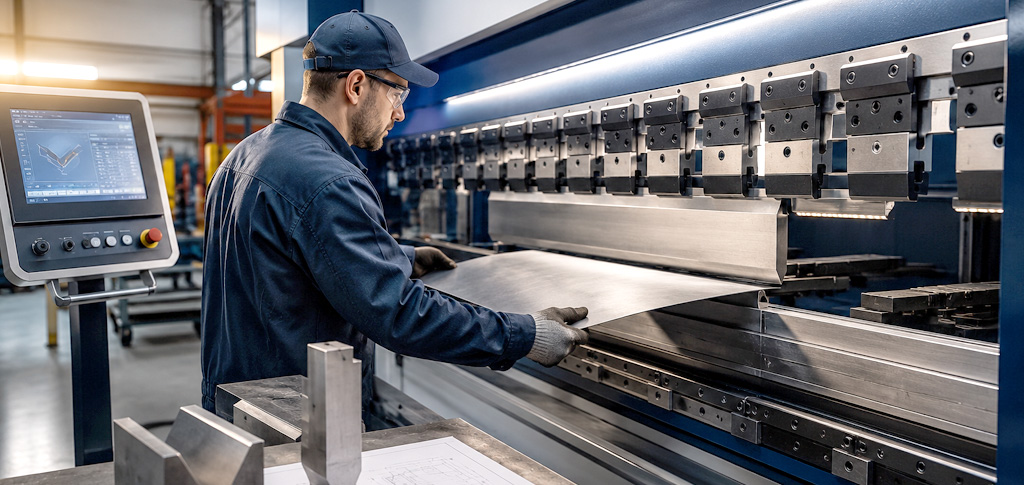
Calculating tonnage is an essential step in any sheet metal bending operation. If you want to quickly obtain an estimate of the force required, you can use our tonnage calculator. However, it is often underestimated, particularly when modern press brakes are equipped with numerical controls capable of automatically performing some of the calculations. While these systems greatly facilitate the operators' work, they do not replace a thorough understanding of the parameters that influence bending force.
Inaccurate tonnage estimation can lead to several problems: inaccurate angles, increased springback, premature wear of punches and dies, and even overloading of the press brake. Conversely, accurately determining the required force improves part quality, reduces setup time, increases tool life, and optimizes shop productivity.
Whether you use a hydraulic press brake or a CNC press brake, Understanding how to calculate tonnage will help you choose the right parameters and produce compliant parts from the first fold.
In this guide, we explain the factors that influence tonnage, the calculation methods used in the industry, the errors to avoid, and the best practices for achieving accurate and repeatable bends.
What is the tonnage of a press brake?
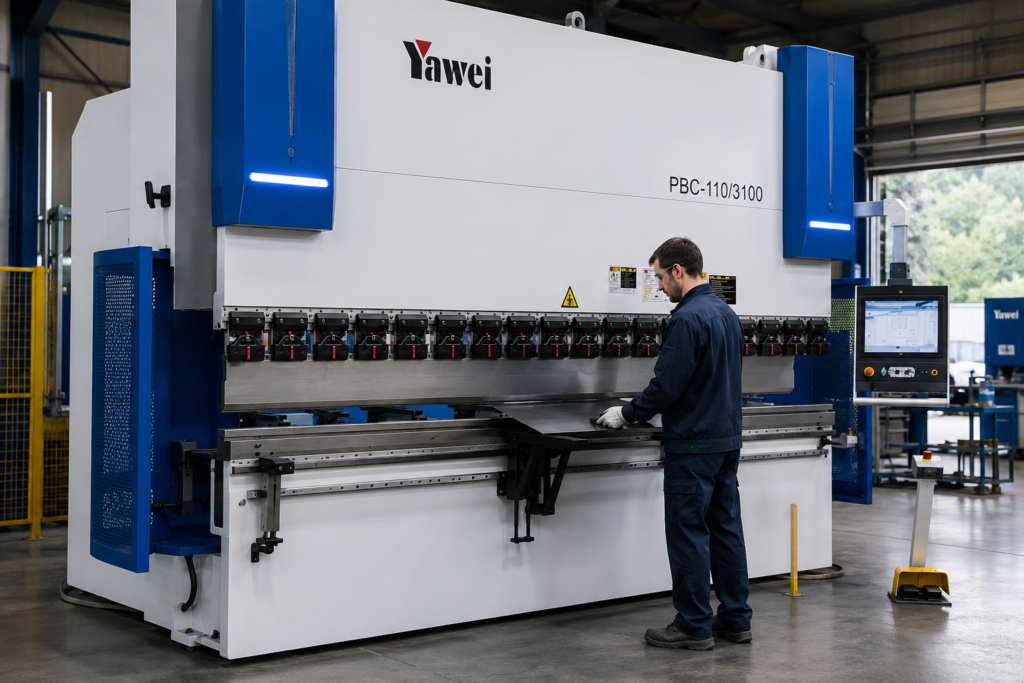
Tonnage represents the force developed by a press brake to permanently deform a sheet of metal. This force is generally expressed in tonnes or kilonewtons (kN) and is one of the main technical characteristics of a machine.
Each press brake has a maximum capacity determined by its design. 175-tonne press, For example, it is capable of exerting a maximum force of 175 tonnes distributed along its working length. However, this does not mean that all bending operations require such power. In most applications, the actual tonnage used is well below the machine's maximum capacity.
The objective is therefore to determine the minimum force required to obtain a conforming bend, without unnecessarily stressing the press or the tools.
Why is tonnage calculation so important?
Calculating tonnage is not just about checking if a press is powerful enough. It directly influences the quality of the parts produced, the safety of operations, and the profitability of the workshop.
Insufficient tonnage can prevent the sheet metal from reaching the desired angle. The operator will then have to make several attempts, adjust the settings, or manually correct certain parts. This situation leads to wasted time, decreased productivity, and an increased risk of scrap.
Conversely, applying excessive force does not produce a better result. Overloading increases stress on the machine structure, accelerates wear on punches and dies, and can, in the long term, reduce the lifespan of the press brake.
Accurate tonnage calculation allows, in particular:
- to obtain consistent angles from the first fold;
- limit rework and adjustments;
- reduce tool wear;
- preserve the performance of the press brake;
- improve the repeatability of productions;
- reduce manufacturing costs.
- In a context where companies seek to increase their productivity while controlling their costs, this step constitutes a real lever for performance.
The main factors that influence tonnage
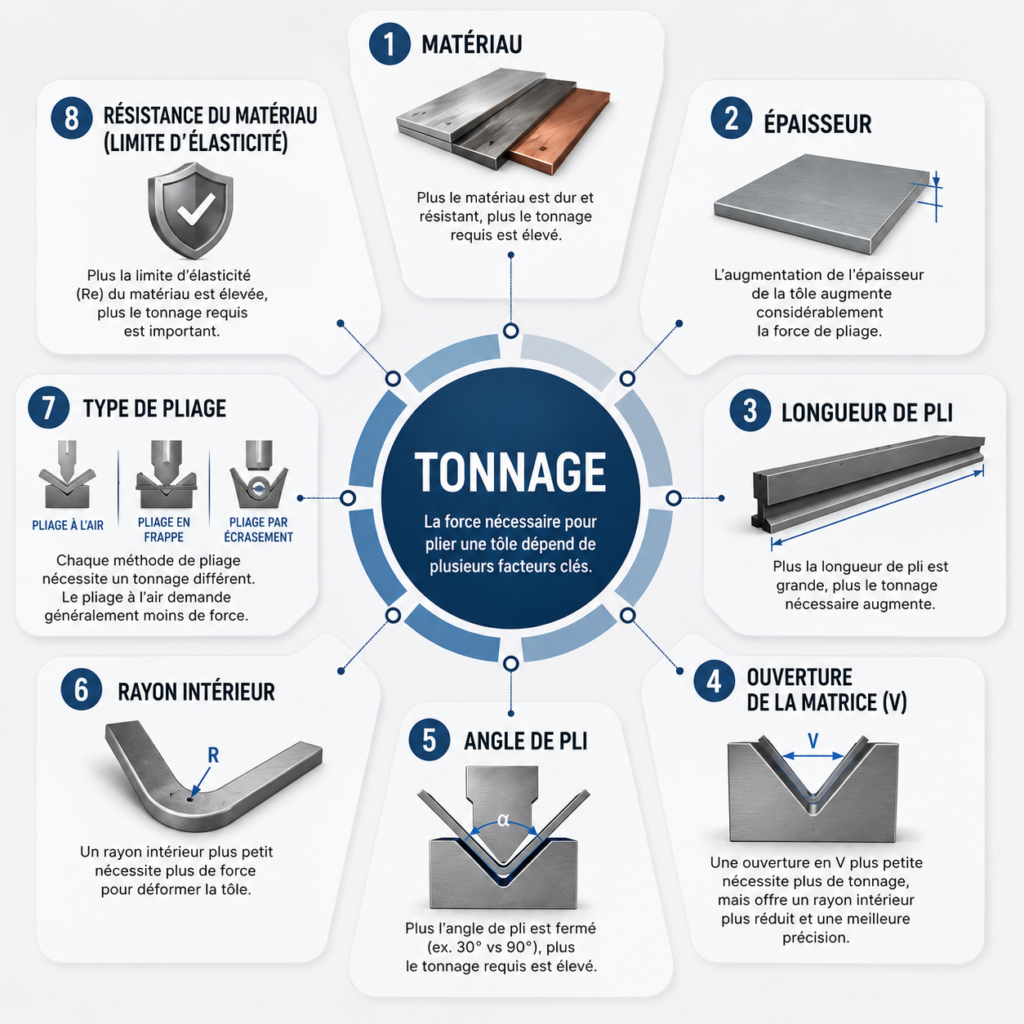
Contrary to popular belief, tonnage does not depend solely on the thickness of the sheet metal. Several parameters come into play simultaneously, and each can have a significant influence on the force required.
The material
Not all metals have the same mechanical strength. Mild steel sheet will generally be easier to bend than stainless steel or high-yield-strength steel sheet. The more resistant a material is to deformation, the more force the press must exert to achieve the desired bend. This is why tonnage charts often differentiate between various types of materials.
The thickness of the sheet metal
Thickness is one of the most critical factors. Even a relatively small increase in thickness results in a significant increase in the force required. A 6 mm sheet of metal doesn't simply require twice the force of a 3 mm sheet; the increase is much greater. Therefore, it is essential to know the actual thickness of the material before any bending operation.
The length of the fold
The force exerted by the press is distributed along the entire bending length. The longer the bend, the greater the total tonnage. A three-meter part will therefore require more power than an identical one-meter part.
The opening of the matrix
The choice of die also plays a major role. A larger die opening generally reduces the tonnage required but increases the inside radius of the bend. Conversely, a narrower die improves accuracy but requires more force. Tooling selection should always adhere to the manufacturer's recommendations to ensure a balance between accuracy, finish quality, and machine capacity.
The folding method
The tonnage also varies depending on the process used.
The three most common methods are:
- Air bending;
- the bottoming fold;
- folding by crushing (Coining).
- Air bending is now the most widely used process in the industry because it generally requires less force while offering excellent flexibility.
How is tonnage calculated?
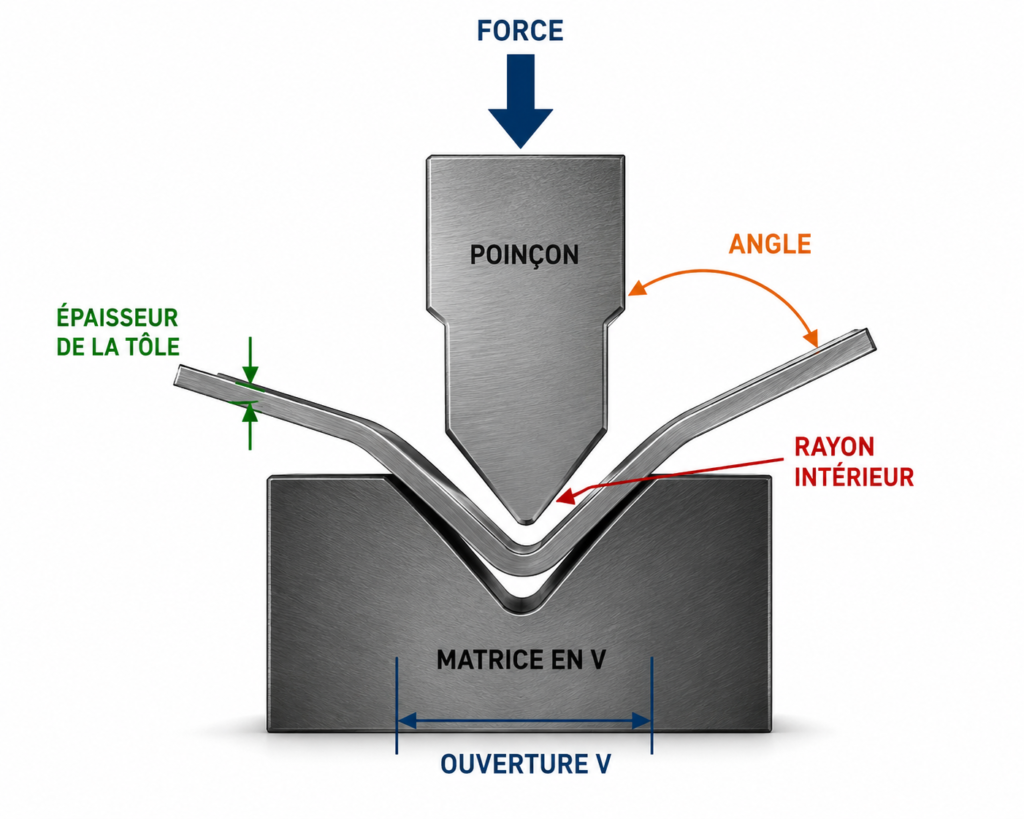
The tonnage calculation is based on several combined parameters:
- the type of material;
- its thickness;
- the length of the fold;
- the opening of the matrix;
- the mechanical strength of the material.
Manufacturers of press brakes and tooling use standardized formulas that take these variables into account. In practice, most workshops do not perform these calculations manually. They rely on tonnage tables or calculators integrated into CNC machines.
These tools allow for a quick and reliable estimate of the force required, while limiting the risk of error.
If your workshop regularly carries out bending operations, we also recommend that you use the tonnage calculator available on our site, which is an excellent complement to the reference tables presented below.
Indicative tonnage table for air bending of mild steel (90°)
Important: The following values are provided as a guide for air bending of standard mild steel. Actual tonnage depends on factors such as material strength, bend length, die opening, tooling type, and your press brake manufacturer's recommendations.
| Sheet metal thickness | Recommended matrix opening (V) | Approximate tonnage per meter |
|---|---|---|
| 1 mm | 8 mm | 4 to 5 tonnes |
| 1.5 mm | 12 mm | 7 to 9 tonnes |
| 2 mm | 16 mm | 11 to 13 tonnes |
| 3 mm | 24 mm | 24 to 26 tonnes |
| 4 mm | 32 mm | 42 to 45 tonnes |
| 5 mm | 40 mm | 65 to 70 tonnes |
| 6 mm | 48 mm | 90 to 100 tonnes |
| 8 mm | 64 mm | 160 to 175 tonnes |
| 10 mm | 80 mm | 250 to 270 tonnes |
This table clearly highlights the influence of thickness on bending force. Between a 2 mm sheet and a 6 mm sheet, the required tonnage is not multiplied by three, but by almost eight. This difference demonstrates that it is impossible to estimate bending force "by eye." Every change in material, thickness, or tooling must be validated before production begins.
It is also important to remember that these values are based on standard mild steel bent at 90°. Using stainless steel, high-strength steel, or an aluminum alloy will change the required forces. For an estimate tailored to your application, use our tonnage calculator or consult the technical data provided by your machine and tool manufacturer.
Good to know
A common rule of thumb in the industry is to select a die opening approximately eight times the sheet thickness for air bending mild steel. This is an excellent starting point and generally provides a good balance between bend quality, inside radius, and required force. However, this rule does not replace the manufacturer's recommendations. Depending on the material, application, or accuracy requirements, a different opening may be preferred.
Concrete example
Imagine a workshop needs to bend a 3 mm thick mild steel sheet to a length of 1500 mm. Before starting production, the operator consults the tonnage chart or uses the calculator available on the Garant Machinerie website. They then verify that the press has sufficient capacity, select the appropriate die, and program the recommended parameters into the CNC control.
This check takes only a few minutes, but it avoids unnecessary trials, reduces scrap, and ensures a compliant first part. In a production environment, these few minutes saved on each batch represent a significant productivity gain over the course of a year.
The most frequent errors when calculating tonnage
Even with a modern press brake equipped with CNC control, tonnage calculation should never be considered a simple formality. Integrated software greatly simplifies the operator's work, but it relies on the data provided. Incorrect information or the wrong tooling selection can lead to significant errors.
Here are the main errors observed in metal fabrication workshops:
Underestimating the material's strength
One of the most common mistakes is to assume that all steels behave the same way. However, two sheets of the same thickness can have very different mechanical strengths depending on their composition or manufacturing process.
For example, stainless steel or high-yield-strength steel will generally require more force than standard mild steel. If this difference is not taken into account when programming the press brake, the resulting angle may differ from the expected one, and several corrections will be necessary. To minimize this risk, it is recommended to use the mechanical properties provided by the material supplier or the data integrated into the press brake software.
Using an inappropriate matrix opening
The choice of die directly influences the quality of the bend and the required tonnage. An opening that is too small significantly increases the bending force and puts more stress on the punches and the press structure. Conversely, an opening that is too large reduces the tonnage but increases the inside radius of the bend and can compromise dimensional accuracy.
The choice of matrix opening must therefore always be made according to:
- of the material;
- of its thickness;
- of the desired interior radius;
- recommendations from the tool manufacturer.
This step is often overlooked, even though it directly influences the lifespan of the tools.
Working near the press's maximum capacity
Some companies choose a press whose capacity exactly matches their current needs. However, this approach leaves very little room for error when materials change or new parts need to be produced. Regularly using a press near its maximum capacity increases mechanical stress on the machine and accelerates wear on its components. Whenever possible, it is best to maintain a safety margin to preserve the equipment's performance over the long term.
Neglecting the condition of the tools
Even with perfectly calculated tonnage, worn tooling can compromise the quality of the parts produced. Damaged punches or dies showing signs of wear can alter the bending angle, increase the required forces, and generate defects in the parts. A regular tool inspection and maintenance program is therefore a worthwhile investment for maintaining consistent quality.
How to optimize tonnage without compromising quality?
The goal is not to use the highest possible force, but to find the best balance between quality, precision, and productivity. Several best practices can optimize bending operations.
Choosing the right tools
The choice of punches and dies must always be adapted to the material as well as the geometry of the part.
Properly sized tools reduce the applied forces while improving the quality of the bend.
Check the material properties
The mechanical characteristics of a sheet of metal can vary depending on the supplier or the manufacturing batch.
For demanding productions, it is recommended to use actual material data rather than generic values.
Utilizing the advanced functions of CNC press brakes
Modern press brakes now have numerous functions that improve bending accuracy:
- automatic calculation of tonnage;
- compensation for curvature;
- correction of elastic return;
- tool libraries;
- simulation of folding sequences.
These features significantly reduce preparation times while improving the repeatability of operations.
- Maintain the machine regularly
- A well-maintained press retains its accuracy for longer.
Preventive maintenance allows, in particular, for:
- maintain the accuracy of the axes;
- limit the wear and tear on hydraulic or electrical components;
- improve security;
- extend the machine's lifespan.
The advantages of an accurate tonnage calculation
Accurate calculation is much more than a simple preparation step. It directly contributes to the overall performance of the workshop. Key benefits include:
- improved precision of bending angles;
- a reduction in rework and adjustments;
- a reduction in waste;
- improved repeatability of series;
- less wear on punches and dies;
- a reduction in maintenance costs;
- an increased lifespan of the press brake;
- an improvement in operator safety.
In the long term, these gains make it possible to increase the profitability of operations while improving the quality of the parts manufactured.
Tonnage calculator or tonnage table: which to use?
The two tools are complementary. The tonnage table is an excellent reference for understanding the influence of thickness, material, or die opening on the required force. It also allows for quick verification of the consistency of a calculation. The tonnage calculator, on the other hand, offers a more precise estimate by taking into account the parameters specific to each application.
For best results, we recommend consulting the tonnage table presented in this guide and then using the tool. Garant Machinery tonnage calculator to confirm the values before programming your press brake. This double check is good practice, especially when manufacturing new parts or changing materials.
Key points to remember
Tonnage calculation is fundamental to industrial bending. Accurate estimation not only ensures conforming parts on the first try but also extends the lifespan of punches, dies, and the press brake itself. Combined with appropriate tooling, rigorous programming, and high-performance equipment, it directly contributes to improved production quality and shop profitability. To quickly estimate the force required for your application, use Garant Machinerie's tonnage calculator or contact our team for project-specific advice.