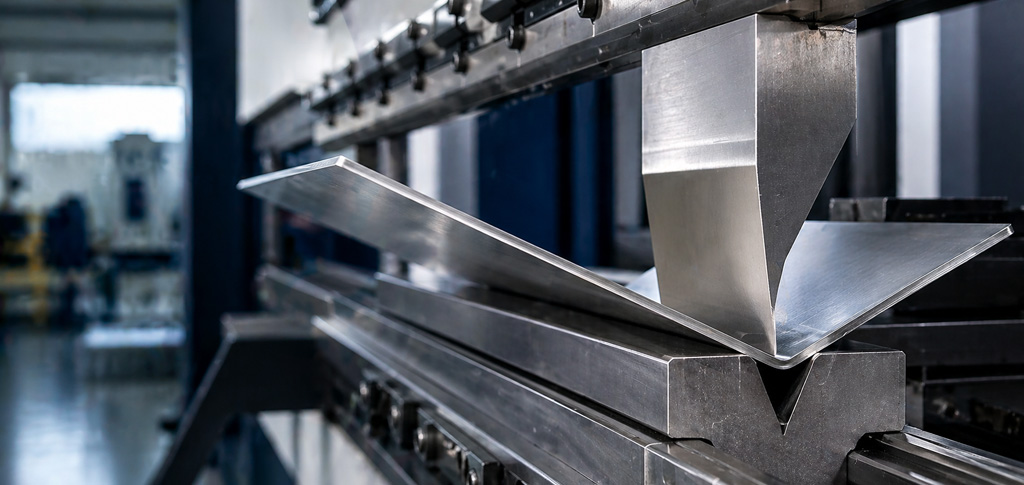
Bending stainless steel is an essential operation in industrial sheet metal work, but also one of the most demanding. Unlike mild steel or aluminum, stainless steel has specific mechanical characteristics that complicate its shaping: high elasticity, significant springback, and sensitivity to visual defects.
Mastering the bending stainless steel This not only improves the quality of the parts produced, but also reduces waste and optimizes workshop productivity. Here's everything you need to know to ensure the success of your operations.
Stainless steel has mechanical properties that make it more complex to work with than other metals.
One of the main challenges is springback. After bending, stainless steel tends to partially return to its original shape.
Result :
Stainless steel is harder than standard steel. This means:
Visual appeal is often critical, particularly in the following sectors:
The slightest defect (scratch, tool mark) can render the part unusable.
Angle accuracy
Elastic rebound makes it difficult to obtain precise angles, especially in repetitive sets.
Crack management
A bend radius that is too small can cause:
Surface deformation
Stainless steel surfaces can:
To successfully bend stainless steel, it is essential to correctly adjust the machine parameters.
General rule:
Stainless steel requires higher pressure than mild steel.
To be expected:
To obtain the desired angle:
Example :
A matrix that is too narrow can:
Recommendation :
The choice of tools is crucial for the final quality.
polished or treated tools
To avoid marks:
Tools suitable for stainless steel
Stainless steel wears out standard tools more quickly. It is recommended to opt for:
Surface protection
Possible solutions:
The folding should ideally be done:
Using a lubricant can:
Before production:
Essential for critical parts
On a CNC press brake:
Underestimating the elastic return
This results in:
Using unsuitable tools
Consequences :
Choosing a radius that is too small
Risk :
Neglecting surface quality
In some sectors, aesthetics are as important as precision.
The choice of machine plays an important role.
Ideal for:
Benefits :
Recommended for:
Benefits :
The solutions offered by manufacturers such as Schröder Or Yawei are particularly suited to the requirements of stainless steel bending, especially for applications requiring a perfect finish.
Discover our range of press brakes high-performance stainless steel bending machines from Garant Machinerie.
Standardize the settings
Create databases by:
Train the operators
A good setting often depends on field experience.
Investing in suitable machines
Modern machines allow:
Bending stainless steel requires rigor, precision, and expertise. Between springback, the risk of cracking, and aesthetic requirements, every parameter must be controlled.
By adopting the right settings, choosing suitable tools and applying good workshop practices, it is possible to obtain reliable and reproducible results.
For sheet metal companies, optimizing stainless steel bending represents a real performance lever: less waste, better quality and time savings in production.