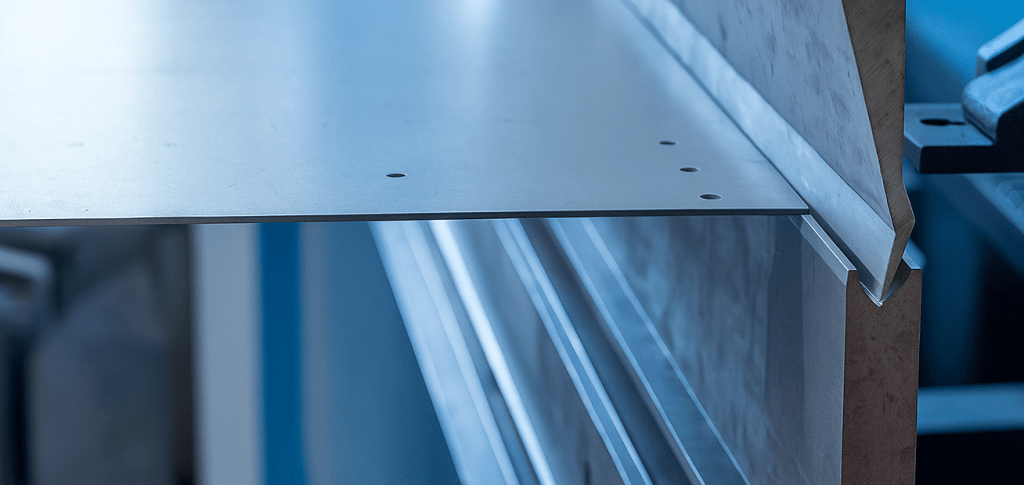
Bending with a press brake is a process commonly used in industry to form metal sheets by giving them a precise curve or angle. Here are the common types of bending performed with a press brake:
Description: The sheet metal is partially pressed between the punch (upper tool) and the die (lower tool), but without touching the bottom of the die.
Benefits :
Allows great flexibility in corners.
Requires less force compared to other methods.
Disadvantages:
Accuracy depends on variations in thickness and hardness of the material.
Description: The sheet metal is pressed until it touches the bottom of the die, ensuring a precise angle.
Benefits :
High precision in the bending angle.
Good repeatability.
Disadvantages:
Requires greater force.
Risk of increased tool wear.
Description: The sheet metal is completely crushed between the punch and the bottom of the die, which prints the exact shape.
Benefits :
Very high precision and dimensional stability.
Disadvantages:
Consumes a lot of energy.
Requires sturdy tools.
Description: Produces two close folds to create a Z-shaped offset.
Applications: Used to manufacture parts where surfaces must be parallel but at different heights.
Description: The press brake is equipped with specific tools to obtain a controlled bending radius.
Advantages: Suitable for sensitive materials where sudden bending could cause cracks.
Description: The sheet metal is bent and then crushed to obtain a flat and safe edge.
Applications: Used for aesthetic finishes or to reinforce an edge.
Description: Technique taking into account the elastic return of the material to obtain the desired final angle.
Benefits: Increased accuracy for high resilience materials.
Description: The press is set to produce asymmetrical or complex shapes.
Applications: Used for special designs.
Important factors in bending with a press brake:
Choice of tools (punches and dies): Depends on thickness, type of material, and type of bending.
Bending parameters: Pressure, speed and angle must be adjusted precisely.
Material: Thickness and mechanical properties influence the process.
Elastic Return: Must be compensated to ensure accuracy.
Before starting production, it is important to validate the folding parameters used. You can use our tonnage calculator and bending development to quickly estimate the force required based on the material, sheet thickness and tool configuration.
Sheet metal bending is a mechanical forming operation used to give an angular or curved shape to a metal part. Here is an overview of the main sheet metal bending techniques, their characteristics and applications:
Factors to consider:
Material Type: Aluminum, stainless steel, copper, etc. Each material has different properties (ductility, strength).
Sheet metal thickness: Determines proper method and equipment.
Bend angle and radius: Affect internal stress and bend quality.
Fold Type: Single fold, multiple fold, or complex shape.
The choice of bending technique and production parameters directly influences the quality of the resulting parts. To help you prepare your bending operations, consult our tonnage and bending development calculator.