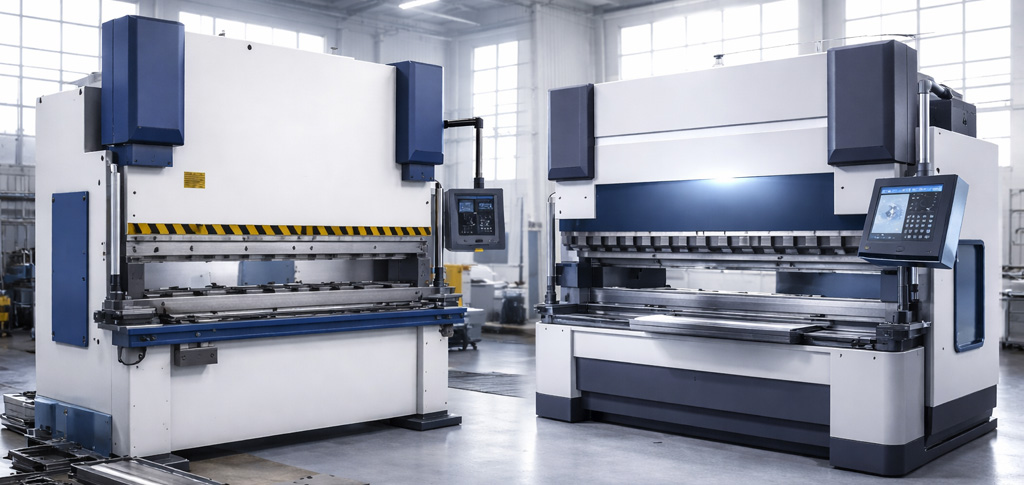
In the industry of metal transformation, the choice of a industrial press brake is a strategic decision. Two major technologies dominate the market: the hydraulic press brake and the CNC press brake (CNC control). Although they may seem similar at first glance, their differences in terms of precision, productivity, automation and operating cost can have a major impact on the performance of a workshop.
Discover all the CNC and hydraulic press solutions offered by Garant Machinery.
This article offers a comprehensive comparison to help manufacturers, sheet metal companies and industrial workshops to choose the solution best suited to their needs.
What is a hydraulic press brake?
The hydraulic press brake is the historical technology in sheet metal bending. It operates using hydraulic cylinders that exert controlled pressure on the metal workpiece to create the desired bend.
Main features
- Hydraulic oil-based pressure system
- Manual or semi-automatic control
- Significant mechanical robustness
- Suitable for thick metal
- Relatively simple mechanical maintenance
Benefits
- High power: ideal for thick or heavy parts.
- Durability: Hydraulic machines are known for their longevity.
- Lower initial cost than some high-end CNC machines.
- Versatility on short or varied series.
Disadvantages
- Limited accuracy compared to advanced digital systems.
- Higher energy consumption.
- Regular maintenance related to oil circuits.
- Slower over long, repetitive sets.
What is a CNC press brake?
The CNC (Computer Numerical Control) press brake incorporates digital control that allows programming of bending angles, depth, speed, and repetition of operations. It can be hydraulic or electric, but what distinguishes it is its level of automation and precision.
Main features
- Touchscreen and software interface
- Programming folding sequences
- High repeatability
- Measurement sensors and automatic correction
- Possibility of robotic integration
Benefits
- Extreme precision on angles and tolerances.
- Increased productivity on large production runs.
- Reduction of human error.
- Optimizing setup times.
- Traceability and archiving of programs.
Disadvantages
- Higher purchase cost.
- Operator training required.
- Specialized electronic maintenance.
- Oversized for very small, simple productions.
Differences between hydraulic press brake and CNC
Accuracy and repeatability
- Hydraulics: Accuracy is highly dependent on the operator.
- CNC: consistent precision thanks to sensors and digital programming.
For parts requiring tight tolerances (aeronautics, electronics, automotive), CNC clearly has the advantage.
Productivity
- Hydraulics: Effective for short series and varied tasks.
- CNC: excellent for large series and continuous production.
A company that produces the same parts all week will benefit more from a CNC machine.
Adjustment time
- Hydraulics: longer manual adjustments.
- CNC: Program memorization, quick tool switching.
In a modern industrial context, the reduction of downtime is a major advantage of CNC.
Investment cost
- Hydraulics: more affordable to buy.
- CNC: higher investment but offset by productivity.
The choice therefore depends on the production volume and the long-term strategy.
Maintenance
- Hydraulics: mechanical maintenance and fluid management.
- CNC: electronic and software maintenance in addition to mechanical maintenance.
CNC machining requires more specialized technical support, but it can reduce costly errors.
Energy consumption
- Hydraulics: constant consumption.
- Electric CNC: often more energy efficient.
With a view to reducing operating costs, electric CNC can represent a financial advantage over several years.
What type of workshop for which machine?
Small workshop or sheet metal shop
A hydraulic press may be sufficient if:
- Volumes are low.
- The rooms are varied.
- The budget is limited.
- Extreme precision is not critical.
Medium-sized manufacturing industry
A hybrid CNC machine is often ideal if:
- The series are regular.
- Tolerances are important.
- Delivery times must be optimized.
Intensive industrial production
Advanced CNC machining is recommended if:
- The volumes are high.
- Errors must be minimized.
- Automation is a strategic objective.
- Robotic integration is being considered.
Impact on profitability
The initial cost of a CNC machine may seem prohibitive, but it needs to be analyzed:
- Waste reduction
- Reduction in training time
- Increased productivity
- Fewer human errors
- Better consistency in quality
Over 5 to 10 years, a CNC can become more profitable than hydraulics, especially in a sustained production environment.
Technological evolution and Industry 4.0
CNC press brakes integrate better into digital environments:
ERP/MES Connection
Production data analysis
Predictive maintenance
Robotic automation
Traditional hydraulics remain reliable, but they are less compatible with smart production lines.
Which press brake brands should I choose?
Several manufacturers offer solutions tailored to the various production needs of metal processing. Among the brands offered at Garant Machinerie are:
Schröder CNC Folding Machines – renowned for their precision and automated bending centers.
Vimercati – Italian manufacturer specializing in high-performance hydraulic press brakes.
RICO – robust and customizable solutions for heavy industry.
Yawei Press Brakes – advanced CNC technologies and strong digital integration.
MECAMAQ – versatile machines for varied production workshops.
Yadon – industrial solutions adapted to large tonnage capacities.
Each manufacturer is distinguished by its level of’automation, its mechanical robustness, its folding precision and its technological positioning. The choice will depend on the production volume, the level of tolerance requirements, and the automation objectives of your workshop.
In summary: which one to choose?
Comparison of CNC vs. hydraulic press brakes
| Criteria |
Hydraulic Press |
CNC Press |
| Precision |
Average |
High |
| Initial cost |
Low to medium |
Pupil |
| Productivity |
Average |
Very high |
| Maintenance |
Mechanical |
Electronics + mechanics |
| Energy |
Higher |
Optimized |
| Automation |
Weak |
Forte |
| Ideal for |
Short series |
Long series |
The verdict: CNC or hydraulic press brake?
The choice between a CNC press brake and a hydraulic press brake depends primarily on the production strategy, the volume of parts, and the level of precision required and available budget.
-
- Hydraulics: a robust, accessible solution suitable for multi-purpose workshops.
- CNC: a modern, precise and industrial performance-oriented solution.
In a context where competitiveness increasingly relies on quality, speed, and automation, the industrial CNC press brake It tends to become the benchmark for companies aiming for long-term growth. However, the hydraulic press remains highly relevant for organizations that prioritize flexibility and mechanical simplicity.