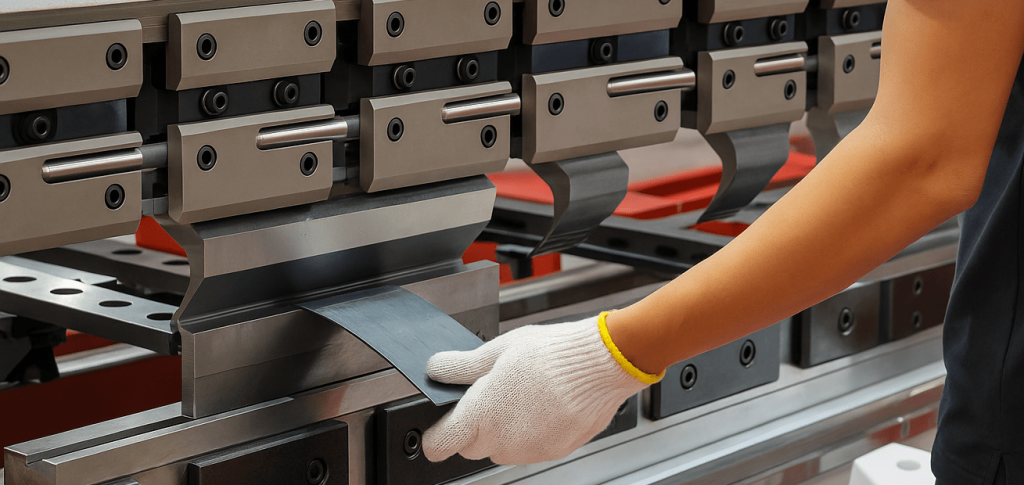
Press brakes have evolved a lot since their beginnings, however, regardless of their degree of sophistication, sources of errors in folding remain present on a daily basis.
The aim of this article is not to detail each source of error in depth but rather to make a summary list, in order to give you some ideas or simply to inform you. We have subdivided these sources of error into 4 groups: the material to be folded, the construction of the press brake, the positioning of the axes and the tools used.
Material
Among these four sources, the most difficult to control is certainly the consistency of the material to be folded. All you have to do is measure the thicknesses of the same material ordered for each of your orders and request a mill test (“Mill Test”). You will be able to see that the characteristics and dimensions can vary considerably. The lower the quality of the material, the more likely you are that the properties and dimensions of the same plate or sheet will vary. The higher quality your material is, the more homogeneous it will be and the stable properties, the better the results will be in terms of folding and the less scrap you will generate. Sometimes it is better to pay a little more for the equipment and avoid some unpleasant and costly problems and expenses.
Construction
The second group concerns the construction of the press brake you are using. New-generation presses are generally equipped with a system to compensate for the deflection of the lower bed and frames. The design and quality of these systems are paramount when bending in multi-station mode or when bending relatively long parts at tonnages exceeding 30% (sometimes less) of your press brake's rated capacity. For example, if you bend to the left, center, or right of the press, the gooseneck-shaped press uprights open differently depending on the bending location. This deflection will affect the bend angle on either side of the part if it is not properly compensated. Furthermore, this deflection of the press uprights tends to shift the punch forward, and consequently, if no mechanism is in place to compensate, the errors accumulate. To facilitate the estimation of bending parameters and reduce the risk of errors, you can also use our tonnage calculator and bending development in order to quickly obtain an estimate tailored to your application.
In terms of table flexion, since the objective is to obtain a constant angle from one end of the part to the other and since the hydraulic cylinders on most presses push at each end, a compensation system Bending of the lower apron (“crooning”) is necessary if you are looking for a minimum of precision. These compensation systems are mainly found in three versions on the market: mechanical, hydraulic-CNC, hydraulic-CNC & Dynamic. The first two types are based on a position estimate by the press controller. The third type, hydraulic-CNC & Dynamic, allows the deflection of the lower deck to be adjusted in real time according to the measured deflection of the upper deck. This type of system is very efficient and greatly increases the quality and consistency of folding, whether for long parts or in multi-station mode.
An equally important and rarely considered aspect is the quality and dimensions of the steel used to manufacture the press. The use of thicker steel plates with a higher elastic limit will reduce the bending of the various components, which will help to improve the straightness and precision of the bent parts.
Also at the construction level, the precision in the positioning of the different axes (top apron, rear stop, etc.) is undoubtedly a very important factor as well. Obviously, proper maintenance is required since cumulative clearances can cause significant errors. The new press brakes, Synchro type (Y1-Y2) equipped with rear stops controlled with ball screws or rack generally offer very interesting precision.
Axis positioning
A third source of potential error lies in the calculation of the final positioning of the axes. From one numerical control manufacturer to another, positioning calculations may differ since they do not all use the same calculation formulas. Consequently the operator must constantly make corrections to the position of the axes when a certain precision is sought. In addition, there are many designers of CAD-CAM conversion software that can generate a folding program from a 2D or 3D drawing and once again they do not all use the same calculations. Good integration between this type of software and your press controller is essential. In addition, the bending data (elastic limit, thickness, length, punch, die) must be entered as precisely as possible in order to minimize sources of error. There are a few real-time angle measuring systems on the market, which take a few measurements during the bending process to determine the material's Spring Back and exact positioning based on the desired angle. Although the concept is very interesting at first glance, the solutions offered to date are quite expensive and often present significant drawbacks (interference with parts, frequent calibration, slowness of the process, etc.) and are often put aside after a few uses.
Tools
The last source of error identified at this time is associated with the tooling used to bend your parts. Very frequently we installed new press brakes and tried to recover the used tools that were in the workshop. The result is more often than not very disappointing. Worn, damaged or distorted tools have a direct impact on precision and quality. Additionally, if your press brake is of a certain age or has been subjected to improper use, the condition of the punch attachment surface and the table can also cause inaccuracies. The basic rules of folding are already known and still prevail. However, you must ensure that you use precise and appropriate tools.
In conclusion, if you use materials with uniform and well-defined properties, and a high-quality press brake with systems that compensate for induced deflection during bending, you have already eliminated a number of potential sources of error. Since the accuracy of the estimate calculated by your press brake's CNC control is difficult to modify, all that remains is to ensure you are using high-quality tools in excellent condition.
Before starting a new production run, use our tonnage and bending development calculator to quickly validate your bending parameters and reduce the risk of manufacturing errors.
Yves Garant, eng.
Manufacturing Advisor